Assembling Patagonia

Sometimes you just feel lucky! In preparation for writing about the geologic history of Patagonia I have been reading papers about the oldest rocks there—aimed at learning how Patagonia was "put together" with the rest of South America during the assembly of the Gondwana super-continent. I had decided to attend the Geological Society of America's March meeting of the Cordilleran...
The Patagonian saga continues

We're back in the USA! Thanks to everyone who followed my explorations of the geology and natural environment in this amazing part of the world—Patagonia. Also thanks for your comments along the way. I wanted to respond to many of them but was sufficiently challenged just getting the initial postings out there. During the upcoming months, I will be focused...
From the cordillera to the capital

Last night in the cordillera—where to stay? Not in Bariloche but west of it, where it's possible to be immersed in mountains, lakes, and sky, rather than atrocious architecture and consumer products. We splurged with a night in a 5-star hotel: the Charming Hotel—who came up that rather silly name? It is on a cliff overlooking Lago Nahuel Huapi with...
The prettiest town in Argentina

We have not visited all of the towns in Argentina, but San Martín de los Andes is the prettiest one we've visited so far. It is situated at the east end of Lago Lácar and at the edge of Parque Nacional Lanín. San Martín is a ski town in the winter; in the summer it's a tranquil base for kayaking,...
Volcanoes past and present

The lake district is in the northwestern part of Patagonia, where the landscape has changed somewhat. In Argentina, the lakes are still on the dry side of the Andes, but the country border here jogs a little westward to capture more of the cordillera with its mountains and green forests. The nothofagus is still here—southern beech tree that evolved when...
La Ruta 40—now and 9,000 years ago

You may be familiar with Highway 50 in Nevada—it is the slow road going east–west. A book about this road is titled "The Loneliest Road in America". It gives a mile by mile description of features along the way (ghost towns, sand dunes, gold mines, etc.). For La Ruta 40 in Argentina, this would be a boring book indeed! Travel...
Whispers of rock

If climbers are straining to conquer the scream of raw stone, geologists are straining to hear the whispers of rock that often yields its secrets reluctantly. Learning to "read the rocks"—to decipher Earth's history—is like reading a story where most of the pages are missing, and the pages that remain are shuffled into a random order. So learning to interpret...
Scream of stone

"Scream of Stone"—an aptly named, feature-length film by Werner Herzog documents the personalities, egos, and drama involved with a climbing expedition to Cerro Torre. It's shot on location and includes stunning footage of the mountains here. Although lower in elevation than Cerro FitzRoy (3100 meters compared to 3400 meters) Cerro Torre makes up for its diminutive stature with steeper slopes,...
A mecca for climbers—and anyone who loves mountains

We are back in Parque Nacional Los Glaciares (Glacier National Park), this time in the sturdy little town of El Chaltén, located right at the edge of the park. It consists of lodging, restaurants, excursion companies—everything geared to the people who come here from all over the world to climb and hike during the summer season. Here is a photo...
Tectonic plates at the end of the world

As we have headed south, we have gotten closer to active plate boundaries - closer to the convergent plate boundary (subduction zone) along the western coast of Chile and closer to Argentina's only plate boundary - the transform boundary between the South American plate and the Scotia plate. Below is a map of the plates in this region. You may...
Ushuaia – el fin del mundo (the end of the world)

Ushuaia is the southernmost city in the world, at 50 degrees south latitude. True, there is the small town of Puerto Williams that is slightly more south, on the south shore of the Beagle Channel, and there is a small scientific settlement (McMurdo Station) in Antarctica, but Ushuaia is a bustling city of about 70,000 people that takes full advantage...
When glaciers dominated this landscape

The photo below is from Cerro Cristales, looking northeast across the valley now occupied by Lago Argentina (lake in the distance) and its narrow western arms (lakes in the foreground). Twenty thousand years ago this valley was filled with glaciers. El Calafate, the popular tourist town that sits on the south shore of Lago Argentina, and that is the base...
About the Blogger
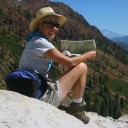 Karen (here with Mt. Shasta in background) is a geology professor emerita who aims to provide a "pocket geologist" for world travelers. Follow the blog to explore the landscapes of our planet and figure out what causes them to look the way they do.